
Our Workshops
CommiVance offers a suite of science‑driven communication workshops built specifically for personal injury law firms. Each session is grounded in trauma‑informed care and behavioral psychology, translating the research into practical scripts, conversation frameworks, and real‑world scenarios your team recognizes instantly. From trauma‑informed intake and expectation setting to difficult conversations, de‑escalation, and trust repair, the workshops are designed for attorneys, case managers, intake specialists, and firm leaders who want to improve how they communicate with clients every day, not just on their best days.
Across the series, the focus is consistent: calmer clients, clearer facts, and stronger relationships that you can actually measure. Every workshop includes ready‑to‑use language, simple structures your team can plug into existing processes, and a short set of metrics you can track over the next 8 weeks, such as client satisfaction, communication complaints, and re‑work on files. That way, your investment in training doesn’t just feel helpful in the room; you can see its impact in the way your firm communicates, the feedback clients give you, and the stability of your caseload.

Measurable Results
Every CommiVance workshop is built to be measurable, not just motivational. For each session, firms receive a simple scorecard that links the skills we teach—like trauma‑informed intake, expectation‑setting, and de‑escalation—to concrete numbers in their practice. That includes short client surveys, a few tracked file-quality indicators (such as re‑intake calls or communication complaints), and quick behavioral checklists supervisors can apply to a sample of calls or meetings. This lets your team see, over the following 4–8 weeks, how new language and structures are changing client satisfaction, reducing friction, and improving how cleanly information is captured—so you can point to clear, defensible data when you talk about the impact of the training.
Current Workshops
Trauma‑Informed Intake Workshop
This CommiVance™ Workshop is a live educational training in person or via Zoom
designed to help personal injury firms improve communication across the client experience. This session explores how communication breakdowns impact trust, client understanding, and overall firm relationships.
Through psychology-informed communication strategies, firms learn how to strengthen clarity, reduce confusion, and create more consistent client interactions across intake, case management, and legal support roles.
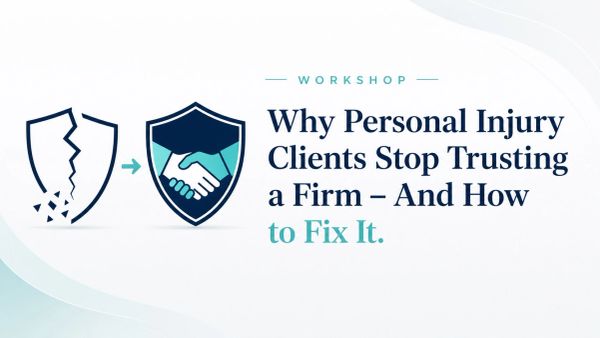
Why Personal Injury Clients Stop Trusting A Firm; And How To Fix It Workshop
The CommiVance™ Mini Workshop is a live educational training via Zoom or in person, designed to help personal injury firms improve communication across the client experience. This session explores how communication breakdowns impact trust, client understanding, and overall firm relationships.
Through psychology-informed communication strategies, firms learn how to strengthen clarity, reduce confusion, and create more consistent client interactions across intake, case management, and legal support roles.
Difficult Conversations & De-Escalation
This 60‑minute workshop helps personal injury firms handle tense client conversations without damaging trust or losing control of the case. It focuses on what to do when clients are angry, anxious, second‑guessing advice, or convinced they’re being “sold out” on value, and shows attorneys and staff how to de‑escalate while staying candid about risks and outcomes.
Participants learn a clear, step‑by‑step approach to difficult conversations grounded in behavioral psychology and trauma‑informed communication. You’ll practice skills like recognizing escalation cues early, validating emotion without admitting fault, using calm, structured language to reset expectations, and redirecting the discussion back to shared goals. By the end, your team will leave with practical phrases, conversation maps, and de‑brief habits they can use the next time a call turns heated, so fewer conflicts spin out, more clients feel heard, and the firm’s reputation and relationships stay protected.
Founder Story
Meet Deanna Soltane
Deanna Soltane
Founder, CommiVance
B.A. Communications & Mass Media | Paralegal Studies | 6 Years in Personal Injury Law Firms
CommiVance was founded by Deanna Soltane after years of working inside personal injury law firms and witnessing how communication breakdowns quietly impact both clients and legal teams.
After earning an associate degree in paralegal studies, Deanna spent six years working within personal injury practices where she observed recurring communication challenges affecting intake, case flow, client understanding, team coordination, and overall firm experience.
These patterns sparked a deeper interest in why communication fails, especially in high-emotion legal environments where clients are often overwhelmed, uncertain, and navigating life-changing situations.
Driven to better understand the science behind communication, Deanna earned a bachelor’s degree in communications and mass media, expanding her focus into communication strategy, behavioral science, psychology, research, and human understanding.
Through this combination of legal experience and communication education, she developed The CommiVance Method™, a framework designed specifically for personal injury law firms.
The CommiVance Method™ combines communication strategy, scientific research, psychological principles, and evidence-based theory to create structured education for attorneys, intake teams, paralegals, and legal staff.
